Is PiP (Picture in picture) Safe? — Extension Safety Profile
Quick verdict: PiP (Picture in picture) earns a safety grade B, 75.4 out of 100, based on 5 of 5 dimensions.
75.4/100
Grade B · 5 of 5 checks
What we found
Automated safety profile from public signals (the extension's manifest & permissions, store listing, publisher, privacy policy). A full review hasn't been published yet.
What this safety grade means
PiP (Picture in picture) earns a safety grade of B (75.4/100), measured across 5 of 5 dimensions. Its strongest area is Maintenance & Ownership (100%). The weakest is Publisher & Identity (60%) — what holds its grade back the most.
On the public records we can check, PiP (Picture in picture) looks broadly trustworthy. 200,000 active users/installs reported on the store. Store rating 4.2/5 from 355 user ratings. Last updated on the store 2026-04-21. This is an automated profile, not a hands-on review — so treat the grade as a starting point: open PiP (Picture in picture)'s own store listing and privacy policy before installing, and weigh it against the other browser extensions we track below.
Safety Signals
Based on 5 of 5 safety dimensions
| Dimension | Score | Bar | Source |
|---|---|---|---|
| Publisher & Identity | 60% · 4.8/8 pts | Automated signals | |
| Permissions & Access | 65% · 16.2/25 pts | Automated signals | |
| Data & Privacy | 83% · 13.2/16 pts | Automated signals | |
| Maintenance & Ownership | 100% · 7.5/7.5 pts | Automated signals | |
| Community Reputation | 84% · 8.4/10 pts | Automated signals |
In-depth safety analysis
This extension requests the scripting API permission paired with host access for <all_urls>. That combination lets it inject scripts into any website you visit, giving it the ability to read and modify page content, including form data, messages, and video elements. For a picture-in-picture tool, access to every page is expected — it needs to detect compatible videos wherever you browse — but the scope is very broad and technically exceeds what a casual user might assume is needed just to pop out a video.
General-purpose extensions with “all sites” access should be approached with care. Even if the developer is well-intentioned today, a future update, a transfer of ownership, or a compromise could turn that access into a privacy risk. The publisher declares they don’t sell data or use it for unrelated purposes, which is a positive signal, but such statements are self-reported. A careful user should consider whether they trust the publisher with complete visibility into every website they open.
The fact sheet shows a clear strength in Maintenance & Ownership (100%), meaning the extension is actively maintained and recently updated — a good sign for security patches. The weakest spot is Publisher & Identity (60%), indicating a lack of strong, verifiable trust signals about who stands behind the software. With decent community ratings (4.2/5 across 355 reviews), it appears functional and tolerated, but the low publisher transparency is worth noting before granting sweeping access.
AI-assisted analysis of the documented signals above (permissions, store data, privacy practices) — explains what they mean and the risks typical for this category. Not a hands-on test.
What the store listing shows
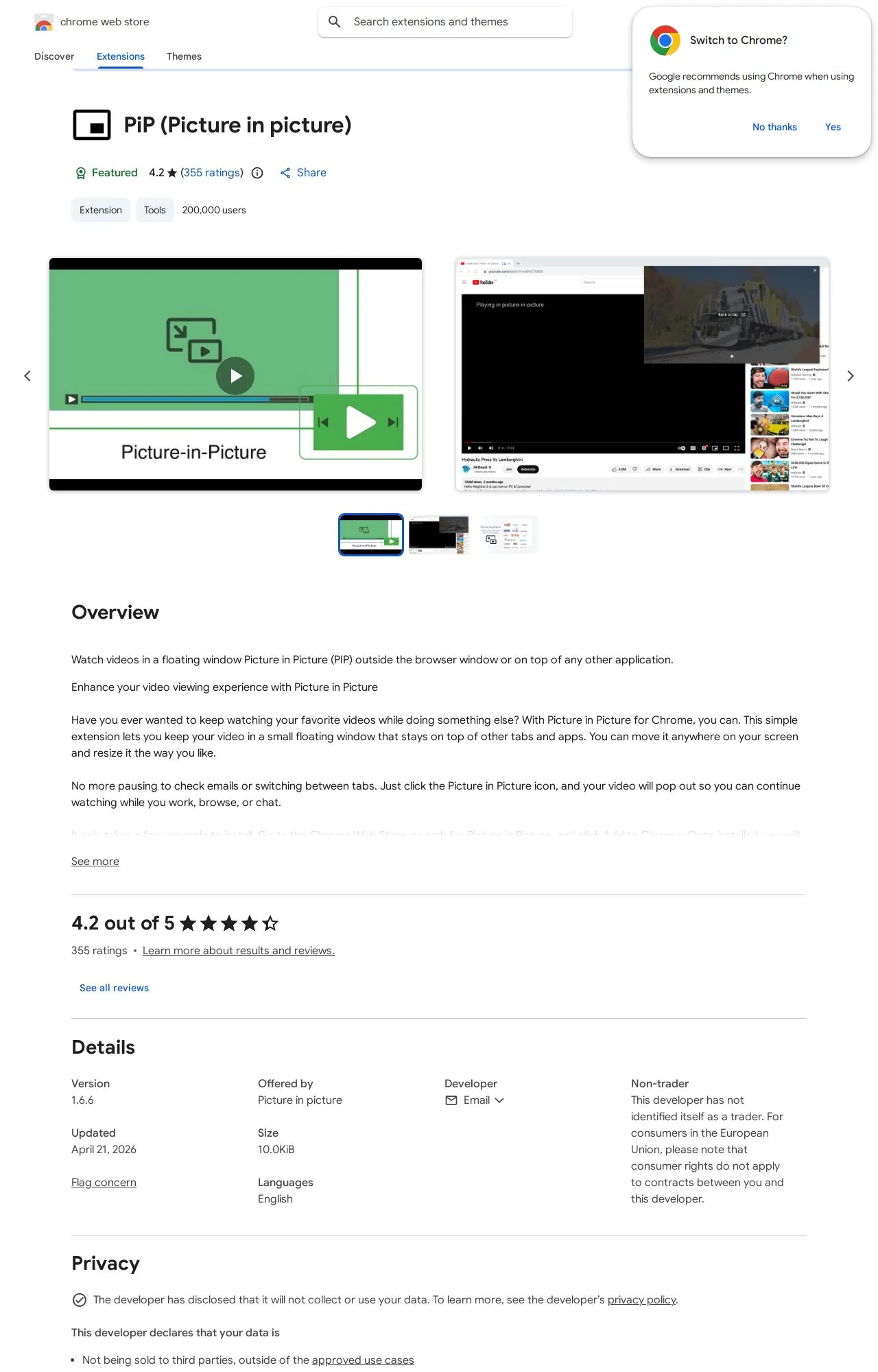
Who's Behind PiP (Picture in picture)?
- Publisher Picture in picture
Public records identify the publisher, but no individual founders or a separate registered company are named — which is what holds the Publisher & Identity score back. Less public information about who operates an extension means less you can verify about their long-term accountability.
How it compares
Among the 369 browser extensions we track, PiP (Picture in picture) scores higher on safety than 45% of them.
Computed from our own database of assessed browser extensions — updated as we track more.
Evidence on File (12)
PiP (Picture in picture) FAQ
- Is PiP (Picture in picture) safe?
- PiP (Picture in picture) earns a safety grade of B (75.4/100) on our evidence-based assessment, based on 5 of 5 safety dimensions we could verify from public records. This is an automated profile built from public records, not a hands-on review.
- Who is behind PiP (Picture in picture)?
- PiP (Picture in picture) is operated by Picture in picture.
Browse all browser extensions we've checked →